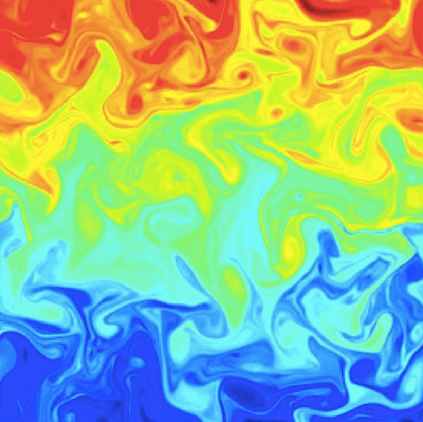
OCEAN EDDIES ARE THE “STORMS OF THE OCEAN”. These rotating vortices of sea water, tens to hundreds of kilometres across and up to 2000m deep, are found ubiquitously throughout the ocean and play a crucial role in ocean circulation, climate, and ecosystem.
We are using satellite and hydrographic data, idealized numerical models, and high-resolution regional ocena models to understand and predict ocean eddies and their role in the regional ecosytems and global climate system
L.G. Bennetts, C.J. Shakespeare, C.A. Vreugdenhil et al. (2024). Closing the loops on Southern Ocean dynamics: From the circumpolar current to ice shelves and from bottom mixing to surface waves. Rev. Geophys. 62(3): e2022RG000781. link
M.C. Denes, G. Froyland and S.R. Keating (2022). Persistence and material coherence of a mesoscale ocean eddy. Phys. Rev. Fluids 7(3): 034501. link
M. Archer, A. Schaeffer, S.R. Keating, M. Roughan, R. Holmes, L. Siegelman (2020). Observations of submesoscale instability within the mesoscale eddy field of the Tasman Sea. J. Phys. Oceanogr. 50 (5): 1509-1529. link
P. Centina-Heredia, M. Roughan, E. van Sebille, S.R. Keating, G. Brassington (2019). Retention and leakage of water by mesoscale eddies in the East Australian Current system. J. Geophys. Res. 124 (4): 2485-2500. link
M. Roughan, S.R. Keating, A. Schaeffer, P. Cetina Heredia, D. Griffin, R. Robertson,
C. Rocha, I.M. Suthers (2017). A tale of two eddies: The bio-physical characteristics of two contrasting cyclonic eddies in the East Australian Current. J. Geophys. Res. 122 (3): 2494–2518 link
A. Klocker, D.P. Marshall, S.R. Keating, and P.L.Read (2016). A regime diagram for ocean geostrophic turbulence. Q. J. Roy. Meteo. Soc. 142 (699): 2411-2417 link
 Shane Keating